
Intellectual Property
Hot selling product recommendations
View More




















Walking into a modern network closet reveals a hierarchy as clear as any organizational chart. At the access layer, you'll find the diligent workhorses like the Cisco Catalyst C9200-48T-A, connecting every desktop phone, computer, and wireless access point. Further upstream, in the core of the network, resides a different class of hardware—the Cisco Catalyst C9500-40X-A. These two switches represent fundamentally different philosophies within Cisco's Catalyst 9000 series, engineered for distinct missions within the enterprise. One serves as the ultimate connectivity aggregator, while the other acts as the high-speed backbone for the entire digital operation. Understanding their divergence isn't about declaring a winner; it's about matching the right tool to the critical task at hand. The C9200-48T-A excels in bringing dozens of devices onto the network reliably, while the C9500-40X-A is built to ensure that the resulting flood of data has a blisteringly fast and intelligent path to its destination.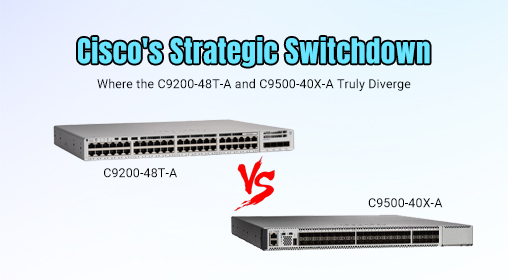
The most immediate difference lies in their physical design and intended placement within the network architecture. The C9200-48T-A is a classic access layer switch, featuring 48 x 1Gbps RJ-45 ports for connecting end-user devices. Its design is compact and practical for wiring closets. In stark contrast, the C9500-40X-A is a core and aggregation layer beast, equipped with 40 x 10Gbps SFP+ ports. This fundamental distinction in port speed and type dictates their entire raison d'être. The C9200 is about breadth of connectivity, handling a high density of gigabit clients. The C9500 is about depth and speed, designed to aggregate traffic from multiple access switches like the C9200 and shuttle it across the network at ten times the velocity. The C9500's more robust chassis supports advanced cooling with field-replaceable, N+1 redundant fan-tray units, a necessity for the heat generated by its high-performance components.
When you examine the raw performance metrics, the gap between access and core roles widens significantly. The C9200-48T-A offers a substantial switching capacity of 176 Gbps, which is more than adequate for providing non-blocking performance to its 48 gigabit ports. The C9500-40X-A, however, operates on another level entirely, boasting a massive 960 Gbps of switching capacity to handle the immense east-west traffic flows typical of a modern campus or data center core. This performance delta is further emphasized in their forwarding rates, with the C9200 capable of 261.9 Mpps versus the C9500's commanding 720 Mpps. This raw power ensures that the core of the network never becomes a bottleneck.
|
Parameter |
Cisco Catalyst C9200-48T-A |
Cisco Catalyst C9500-40X-A |
|---|---|---|
|
Product Series |
Catalyst 9200 |
Catalyst 9500 |
|
Primary Role |
Access Layer |
Core & Aggregation Layer |
|
Fixed Ports |
48 x 10/100/1000BASE-T RJ-45 |
40 x 1/10 Gbps SFP+ |
|
Switching Capacity |
176 Gbps |
960 Gbps |
|
Forwarding Rate |
261.9 Mpps |
720 Mpps |
|
Stacking Technology |
StackWise-160 (160 Gbps bandwidth) |
StackWise Virtual (up to 960 Gbps bandwidth) |
|
Power Supply |
PWR-C6-125WAC (default) |
950 W AC (default, with redundancy options) |
|
Dimensions (HxWxD) |
1.73" x 17.5" x 13.8" (4.4 x 44.5 x 35.0 cm) |
1 RU (Standard 1U rack unit) |
Beyond pure throughput, the feature sets diverge to address the unique challenges of their respective layers. Both run on Cisco's robust IOS XE operating system and support advanced Layer 3 routing protocols. However, the C9500-40X-A, often equipped with the Network Advantage license, pulls ahead with features critical for the core. It supports advanced technologies like MPLS L2/L3 VPNs, VXLAN/EVPN, and NAT, which are essential for segmenting and managing complex network fabrics. Its StackWise Virtual technology allows two physical switches to be clustered into a single logical entity with sub-second failover, a level of resilience demanded in the network core. The C9200-48T-A, with its StackWise-160 technology, offers excellent resiliency for the access layer, but its focus is more on simplified management of multiple stacked units rather than the stateful, active-active redundancy required upstream.
For the network administrator, the experience of deploying and managing these switches is vastly different. The C9200-48T-A is the workhorse you deploy by the dozen. Its value is in consistent, reliable operation at the edge of the network. Setup is straightforward, often leveraging Zero-Touch Provisioning (ZTP) for large-scale deployments. Managing a stack of C9200s provides a single point of administration for an entire wiring closet. The C9500-40X-A, in contrast, commands a different level of attention. Its configuration is more complex, involving critical elements like redundant power supplies, intricate routing policies, and high-availability pairing. The stakes are higher; an error in the core can impact the entire organization. However, its programmability features, including Open APIs (NETCONF/RESTCONF) and streaming telemetry, make it a powerful platform for automation in the hands of a skilled team, providing unparalleled visibility into the network's health and performance.
The conversation about value is entirely dependent on the application. The C9200-48T-A provides exceptional value for its intended purpose as a high-density access switch. It delivers enterprise-grade security, manageability, and reliability for connecting end-users and devices. Its cost is justified by the convenience and scalability it brings to the network edge. The C9500-40X-A represents a significant investment, but it is an investment in the entire network's performance and resilience. For organizations with high internal traffic demands, its ability to prevent congestion and provide advanced services is not a luxury but a necessity. The cost of network-wide slowdowns or outages dwarfs the premium paid for a robust core switch.
In terms of stability and longevity, both platforms are built for continuous operation. The C9200-48T-A has a Mean Time Between Failures (MTBF) of 571,440 hours, reflecting its solid build quality. The C9500-40X-A elevates this with hardware-level redundancies. It features Cisco Nonstop Forwarding with Stateful Switchover (NSF/SSO) and redundant, hot-swappable power supplies and fans. This means the C9500 can survive a component failure without dropping packets or losing network state, a level of fault tolerance that is mandatory for core infrastructure but typically overkill for the access layer.
The choice between these two switches is not a choice at all, but a question of placement. The Cisco Catalyst C9200-48T-A is the undisputed champion of the access layer, perfect for connecting a large number of devices with gigabit speed and intelligent features. The Cisco Catalyst C9500-40X-A is the powerhouse of the core, engineered to be the fast, resilient, and intelligent backbone for the entire network. One gathers the streams, and the other forms the river. For any growing enterprise, both are likely needed, each playing a critical and complementary role in a well-architected, high-performance network.