
Intellectual Property
Hot selling product recommendations
View More




















Cisco Catalyst C9200-24P-E vs Nexus N3K-C3016Q-40GE: A Practical Guide for Network Architects
Choosing the right switch hinges on aligning it with your network’s unique demands. The Cisco Catalyst C9200-24P-E and Nexus N3K-C3016Q-40GE cater to fundamentally different scenarios—one excels at edge connectivity with PoE+ power, while the other is built for high-speed data center backbone duties. Below, we dissect their strengths, weaknesses, and everything in between, avoiding technical jargon while focusing on real-world relevance.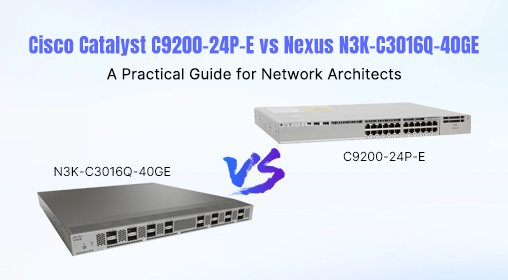
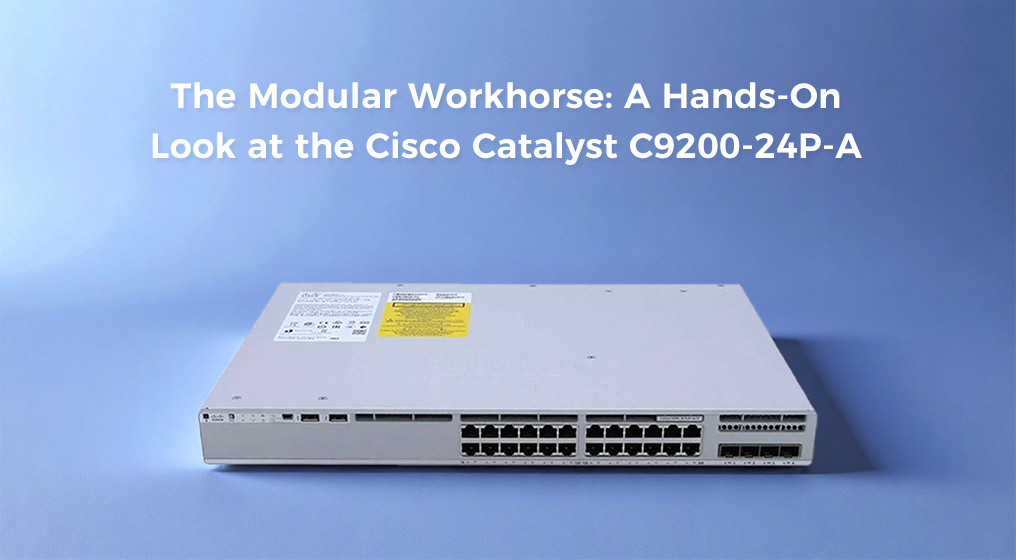
The C9200-24P-E is a 1RU fixed-access switch optimized for edge deployments. It delivers 128 Gbps backplane bandwidth and 190.4 Mpps forwarding rate, sufficient for gigabit access layers. Its 24 Gigabit Ethernet ports include 4x1G SFP uplinks, and it supports PoE+ (30W/port) for powering IP phones, cameras, and wireless APs. Redundant power supplies and fans ensure reliability, while StackWise-480 technology allows up to 16 units to act as a single logical switch .
The N3K-C3016Q-40GE, part of Cisco’s Nexus 3000 Series, targets data centers. It boasts 1.44 Tbps switching capacity and 1.28 Tbps forwarding rate, backed by 16x10G SFP+ ports and 4x40G QSFP+ uplinks. Designed for ultra-low latency (<1μs), it handles high-frequency trading and cloud workloads. Redundant fabrics and liquid cooling options ensure 99.999% uptime in mission-critical environments .
|
Parameter |
C9200-24P-E |
N3K-C3016Q-40GE |
|---|---|---|
|
Port Configuration |
24x Gigabit + 4x1G SFP |
16x10G SFP+ + 4x40G QSFP+ |
|
Uplinks |
1G/10G SFP |
10G/40G QSFP28 |
|
PoE Support |
Full PoE+ (30W/port) |
None |
|
Switching Capacity |
128 Gbps |
1.44 Tbps |
|
Forwarding Rate |
190.4 Mpps |
1.28 Tbps |
|
Primary Use Case |
Campus access, edge deployments |
Data center backbone, cloud cores |
The C9200-24P-E feels like a rugged workhorse. Its compact metal chassis (44.5x4.4x28.8cm) prioritizes durability for harsh environments. Noise levels hover around 42 dB under load, manageable for open-plan offices. Ventilation is basic but effective for non-critical spaces .
The N3K-C3016Q-40GE is built for scalability. Its modular chassis supports hot-swappable components, redundant PSUs, and advanced cooling systems. Designed for 24/7 operation in data centers, it handles sustained high loads with minimal thermal throttling. Weight and size vary but often exceed 15kg, reflecting its enterprise-grade robustness .
Catalyst 9200-24P-E:
Cisco DNA Essentials: Includes SD-Access for automated segmentation and TrustSec for encryption.
StackWise Virtualization: Simplifies multi-switch management.
Basic Layer 3: Static routing and limited dynamic protocols.
Edge-Focused: IoT device management, PoE budget tracking.
Nexus 3016Q-40GE:
Nexus OS: Advanced automation with Python/YAML scripting.
Hypervisor Support: Direct integration with VMware/Hyper-V for VM-aware networking.
Ultra-Low Latency: Prioritized traffic queues for HFT/ML workloads.
Scalability: Supports up to 100G ports and multi-chassis clustering.
For campus admins, the C9200-24P-E is plug-and-play. Its CLI is straightforward, and StackWise simplifies adding units. Stability is rock-solid for access-layer tasks, though it lacks the Nexus’ advanced traffic engineering.
The N3K-C3016Q-40GE demands expertise. Configuring VXLAN, NVGRE, or service meshes requires deep networking knowledge. However, its stability in high-throughput environments is unmatched. Redundant fabrics and hardware-accelerated security (like MACsec) ensure near-zero downtime for critical workloads .
The C9200-24P-E offers better upfront value for edge deployments. Its PoE+ capabilities reduce cabling costs, and the 1RU form factor saves rack space. However, scaling beyond 24 ports or adding 10G uplinks increases expenses.
The N3K-C3016Q-40GE has higher upfront costs but lower TCO in data centers. Its energy efficiency (up to 93%) and multi-tenant support justify the investment for enterprises prioritizing scalability .
C9200-24P-E:
Pros: Affordable PoE+, easy management, compact design.
Cons: Limited to Layer 3 basics, no multi-gigabit ports.
N3K-C3016Q-40GE:
Pros: Future-proof scalability, ultra-low latency, advanced automation.
Cons: Higher complexity, no PoE+, bulkier form factor.
Both switches excel in their niches. The C9200-24P-E handles 24 PoE+ devices without flinching, even in fluctuating environments. Its cooling system manages heat from continuous PoE load but may throttle in extreme temperatures.
The N3K-C3016Q-40GE thrives under relentless traffic. Its redundant power supplies and liquid cooling ensure 99.999% uptime. However, improper configuration (e.g., oversubscribed ports) can lead to bottlenecks .
Choose the C9200-24P-E if:
You need PoE+ for edge devices (IP cameras, WAPs).
Budget constraints prioritize upfront cost over future scalability.
Choose the N3K-C3016Q-40GE if:
Your data center demands ultra-low latency and multi-tenant isolation.
You’re investing in AI-driven networking or cloud-native architectures.
Both are industry stalwarts, but their strengths align with distinct use cases. Match your choice to your network’s heartbeat.