
Intellectual Property
Hot selling product recommendations
View More




















The A9K-2X100GE-TR: Precision Engineering for High-Stakes Networking
Let’s cut to the chase: in the world of high-performance networking, there’s no room for guesswork. The A9K-2X100GE-TR isn’t just another piece of hardware; it’s a meticulously engineered solution for organizations that demand relentless reliability and staggering bandwidth. This module slots into compatible chassis like the Cisco ASR 9000 series, instantly transforming them into powerhouses capable of handling the most demanding data flows. Think of it as adding two superhighway lanes to your network’s backbone—each lane moving data at 100 gigabits per second. It’s built for environments where latency is measured in microseconds and downtime is not an option. Whether it’s a bustling data center, the core of an internet service provider’s network, or a research facility crunching terabytes of data, this module ensures that traffic flows smoothly, predictably, and without interruption .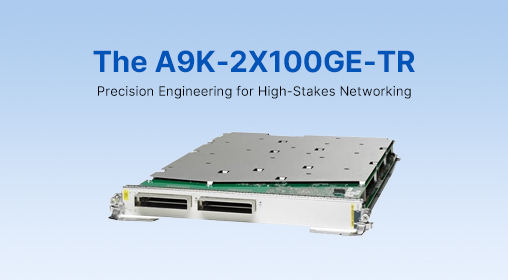
What really sets the A9K-2X100GE-TR apart is its no-nonsense approach to performance. We’re talking about two independent 100-Gigabit Ethernet ports, each engineered to deliver consistent, high-speed data transmission over single-mode fiber. This isn’t just about raw speed; it’s about intelligent throughput. The module supports critical standards like 100GBase-LR4 or ER4, which allow data to travel over long distances without degradation. That means you can connect network segments kilometers apart with confidence. But the real magic lies in its ability to handle multiple high-bandwidth streams simultaneously. It’s like having a team of expert traffic controllers working behind the scenes, ensuring that data packets take the most efficient routes without collisions or delays .
Core Performance Parameters
|
Feature |
Specification |
|---|---|
|
Interface Technology |
100-Gigabit Ethernet (100GE) |
|
Port Density |
2 ports per module |
|
Key Supported Standards |
100GBase-LR4, 100GBase-ER4 (typical for long-haul optics) |
|
Typical Application |
High-density aggregation in core networks and data centers |
|
Physical Medium |
Single-mode fiber (for long-distance transmission) |
|
Design Optimization |
Packet Transport Optimized (TR) for efficient data forwarding |
When you first lay eyes on the A9K-2X100GE-TR, its design tells you everything you need to know. It’s a solid, professional-grade module built with a robust metal casing that dissipates heat efficiently. The front panel is clean and utilitarian, featuring two clearly labeled ports designed for CFP optics. There are no flashy lights or unnecessary embellishments—just a subtle status indicator to confirm operational health. It’s the kind of hardware that looks like it means business, and it does. The compact form factor ensures it fits seamlessly into existing chassis without wasting space, while the sturdy construction promises longevity even in 24/7 operational environments .
But what truly makes this module stand out are the thoughtful features lurking beneath the surface. It’s engineered for stability, minimizing jitter and packet loss that can plague high-speed connections. The module supports advanced traffic management and quality of service (QoS) policies, allowing network administrators to prioritize critical applications effortlessly. Hot-swappable functionality means you can replace or upgrade it without taking the entire system offline—a godsend for environments where every second of uptime counts. And because it’s part of the broader ASR 9000 ecosystem, it integrates smoothly with existing management tools, providing real-time insights into performance and health .
From a user’s perspective, deploying the A9K-2X100GE-TR feels like upgrading from a crowded city road to an open freeway. Network administrators report a tangible drop in troubleshooting headaches. One engineer mentioned, "You stop worrying about bandwidth bottlenecks altogether." Large file transfers that used to crawl during peak hours now complete in a fraction of the time, and latency-sensitive applications like video conferencing or real-time analytics run without a hitch. There’s a quiet confidence that comes with knowing your network can handle unexpected surges—whether it’s a sudden spike in user traffic or a data-intensive new project. It’s the kind of reliability that lets IT teams focus on innovation rather than firefighting .
When it comes to value, the A9K-2X100GE-TR is a textbook example of "you get what you pay for." For large enterprises or service providers, where network performance directly impacts revenue and reputation, its price tag is a strategic investment rather than an expense. By consolidating multiple lower-speed links into two high-capacity ports, it simplifies network architecture, reduces management overhead, and delays the need for costly future upgrades. In the long run, it pays for itself by eliminating the hidden costs of downtime, sluggish performance, and constant hardware tweaks .
Of course, no piece of hardware is perfect for every scenario.
The advantages are compelling: exceptional port density for its size, rock-solid reliability for mission-critical operations, and seamless integration into high-end network ecosystems. It’s built to last and designed to perform.
The considerations are straightforward: this is enterprise-grade hardware with a price to match. It’s overkill for small or medium-sized businesses, and its full potential is only realized when paired with a compatible chassis and expert configuration.
In short, the A9K-2X100GE-TR isn’t for everyone—but for those who need it, it’s nothing short of indispensable.